By Drake Miller – Senior Content Manager and Academic Strategy Consultant
The transition from the classroom to the professional world often feels like stepping into a different universe. For many students in the UK—from those finishing their A-Levels in Bristol to university postgraduates in Manchester—there is a persistent struggle to see how a deep understanding of Victorian literature, organic chemistry, or algebraic topology translates into a monthly paycheck.
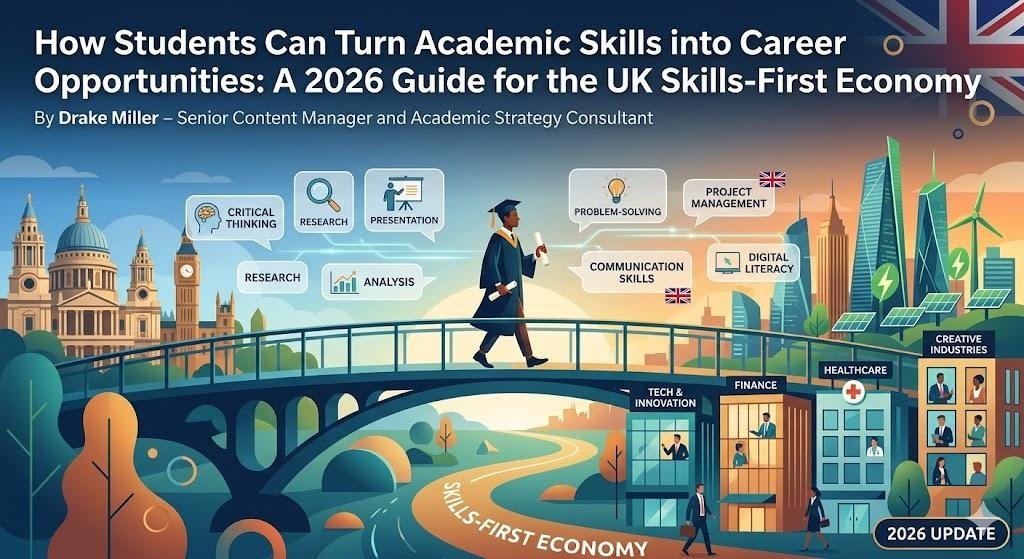
However, the 2026 UK job market has undergone a fundamental shift. We are now firmly in a “skills-first” economy. Employers at top firms in the City of London and the Northern Powerhouse are increasingly less concerned with the specific title of your degree and far more interested in the transferable competencies you developed while earning it. Turning academic success into career opportunities is about more than just listing a GPA or a degree classification on a CV; it requires a strategic translation of academic labor into professional value.
1. Identifying Transferable Academic Skills
The first step in this transformation is recognizing that every essay, lab report, and group presentation was a simulation of a professional task. In the UK, the “Graduate Attributes” framework used by many Russell Group and modern universities highlights several core areas that are highly prized by recruiters.
Critical Thinking and Strategic Analysis
In a biology lab or a history seminar, you aren’t just memorizing facts; you are analyzing data, identifying patterns, and forming logical conclusions. In a corporate setting, this is called “strategic analysis.” When a business faces a decline in user engagement, they need someone who can look at the evidence and propose a solution—the exact same skill used to analyze a complex text or a chemical reaction.
For students in technical fields, these analytical hurdles are even more pronounced. For instance, seeking computer architecture assignment help isn’t just about finishing a task; it’s about mastering the logic of complex systems, a skill directly applicable to systems engineering and IT consultancy roles.
Communication and Technical Writing
High school and university students spend thousands of hours writing. Whether you are seeking biology assignment help to refine a technical report or drafting a dissertation, you are learning how to convey complex information clearly to a specific audience. In the professional world, this translates to writing executive summaries, client emails, and white papers. The ability to take high-level concepts and make them digestible for stakeholders is perhaps the most undervalued skill in the graduate market today.
The pressure of these deadlines often leads students to search for ways to pay someone to do my assignment but the ultimate goal remains the same: producing high-quality, digestible content for stakeholders. This ability to synthesize high-level concepts is perhaps the most undervalued skill in the graduate market today.
Research and Information Literacy
In the age of “fake news” and information overload, the ability to find, verify, and synthesize credible sources is a premium skill. If you can navigate a university library database to find peer-reviewed journals, you can navigate market research tools to find competitor data or consumer trends.
2. The Art of “Skill Translation” on Your CV
A common mistake UK students make is listing their modules without explanation. A CV that says “Module: Macroeconomics” tells an employer very little. A CV that says “Applied macroeconomic modeling to forecast market trends” tells a story of capability.
Quantifying Academic Achievements
To rank well in the competitive UK job market, you must quantify your skills. Instead of saying “I am good at time management,” say: “Successfully balanced a 15-hour weekly lecture schedule with a part-time role and a consistent 2:1 grade average, while accumulating 120 UCAS points in specialized subjects.” This provides “social proof” of your reliability and capacity to handle a high workload.
From “Student” to “Specialist”
If you have spent three years studying Computer Science, you aren’t just a student; you are a Junior Developer in training. Use professional terminology. Instead of “did a group project,” use “collaborated in a cross-functional team to deliver a technical solution under a strict deadline using Agile-inspired workflows.”
3. Leveraging Extra-Curriculars as Professional Proof
For high school students and undergraduates, your “career” often exists in the clubs and societies you join. In the UK, these are seen as “mini-corporations.”
- Society Leadership: Being the treasurer of a Debating Society is equivalent to being a Junior Financial Controller. You managed a budget, handled subscriptions, and perhaps applied for grants.
- Volunteering: Voluntary work provides the “soft skills” that are often hardest to teach: empathy, resilience, and adaptability. These are the traits that help you navigate the “company culture” of a new workplace.
- Digital Presence: For students in the UK, having a LinkedIn profile is no longer optional. It is your digital portfolio. Sharing insights about what you are learning—perhaps a summary of a recent lecture or a thought on an industry trend—positions you as an engaged future professional.
4. Bridging the Gap with Professional Support and Benchmarking
The pressure of maintaining high academic standards while simultaneously building a career profile can be overwhelming. This is where strategic support becomes a functional part of a student’s toolkit. Modern students often look for professional consultancy or ways to do my assignment online—not as a shortcut, but as a method of professional benchmarking.
By observing how experts and academic consultants structure complex arguments or format technical data, students can improve their own “output quality.” In the professional workplace, this is known as “following best practices” or “model-based learning.” Learning how to delegate smaller tasks or seek expert consultation is actually a high-level management skill used by CEOs every day to ensure project success. It demonstrates an understanding of resource management and quality control.
5. Digital Literacy and the Agentic AI Revolution
In 2026, academic skill now includes digital fluency with advanced tools. Understanding how to use Agentic AI and Large Language Models (LLMs) ethically and effectively is a major career opportunity. If you can use AI to assist in your student workflow—for example, using LLMs to brainstorm essay outlines, debug code, or simulate interview scenarios—you are developing a skill that is currently in massive demand across UK tech and marketing sectors.
Employers are no longer looking for people who can do the work manually; they are looking for “AI-augmented” workers who can oversee automated processes. Your ability to show that you used technology to enhance your academic research (while maintaining academic integrity) proves you are ready for the future of work.
6. Networking: The “Hidden” Job Market in the UK
It is estimated that up to 70% of jobs in the UK are never advertised on public job boards like Indeed or Reed. They are filled through networking and “warm introductions.”
Academic Mentors
Your teachers and lecturers are your first professional network. They often have deep ties to industry or know of alumni who are looking for interns. Don’t be afraid to ask for a “coffee chat” (even virtually) to discuss career paths.
Insight Days and Internships
Many UK firms, especially in London, Manchester, and Birmingham, offer “Insight Days” for high school students (Years 12 and 13) and first-year university students. These are golden opportunities to see “skills in action” and put a face to a name before the formal graduate application process begins.
7. Preparing for the Interview: Telling Your Academic Story
The interview is where the “Turn Academic Skills into Career Opportunities” process reaches its climax. The most effective technique for UK interviews—highly favored by the Civil Service and Big Four firms—is the STAR Method:
- Situation: Describe a specific academic challenge (e.g., a difficult group project or a tight dissertation deadline).
- Task: What was your specific goal?
- Action: What academic skill did you apply? (e.g., secondary research, Python coding, or peer review).
- Result: What was the outcome? (e.g., a 1st class grade, a successful presentation, or a streamlined workflow).
By using this framework, you move the conversation away from “what you studied” to “what you can do.” You prove that your time in the library was actually time spent in a professional laboratory of sorts.
Frequently Asked Questions
Q.1 How do I list academic skills on a UK CV if I have no work experience?
Focus on the “Graduate Attributes” developed during your studies. Instead of a “Work History” section, create a “Relevant Technical Skills” or “Key Projects” section. Describe your dissertation or a major group assignment as if it were a professional project, highlighting the software used, the research methodology, and the final result (e.g., a grade or a presentation to faculty).
Q.2 What are the most in-demand transferable skills in the UK for 2026?
Employers are currently prioritizing “human-centric” skills that complement automation. These include complex problem-solving, emotional intelligence, strategic communication, and digital literacy—specifically the ability to manage AI-augmented workflows.
Q.3 Does seeking academic support or “assignment help” look bad to employers?
Not if framed correctly. In a professional context, knowing when to consult an expert or use external resources to ensure the quality of a project is seen as a management strength. Using professional benchmarks to improve your own output shows a commitment to “best practices”—a trait highly valued in corporate environments.
Q.4 How can I prove my AI literacy to a potential employer?
Be specific about the tools and the method. Don’t just say “I use AI.” Instead, explain how you used Large Language Models to assist in data synthesis or how you utilized Agentic AI to automate repetitive research tasks while maintaining the integrity and accuracy of the final report.
Conclusion
The wall between “School” and “Work” is thinner than most students think. Every late-night study session, every difficult exam, and every complex project has equipped you with a toolkit of high-value professional skills. The secret to career success for UK students in 2026 lies in the ability to pivot—to stop seeing yourself as a passive recipient of information and start seeing yourself as a practitioner of valuable competencies.
Whether you are navigating the final years of high school or finishing a postgraduate degree, start translating your academic journey today. Your future employer isn’t looking for a student; they are looking for the problem-solver you have already become.
About the Author: Drake Miller is a senior content manager and academic strategy consultant with over 12 years of experience in higher education and digital strategy. Based in London and Sydney, he specializes in the ethical integration of Agentic AI into student workflows and helping graduates transition into the global workforce through strategic skill translation.